
Form 1099-DA: What It Is, What It Means, and What You Need to Do.
The IRS changed the rules in 2025. Here is what every crypto investor needs to understand before they file.
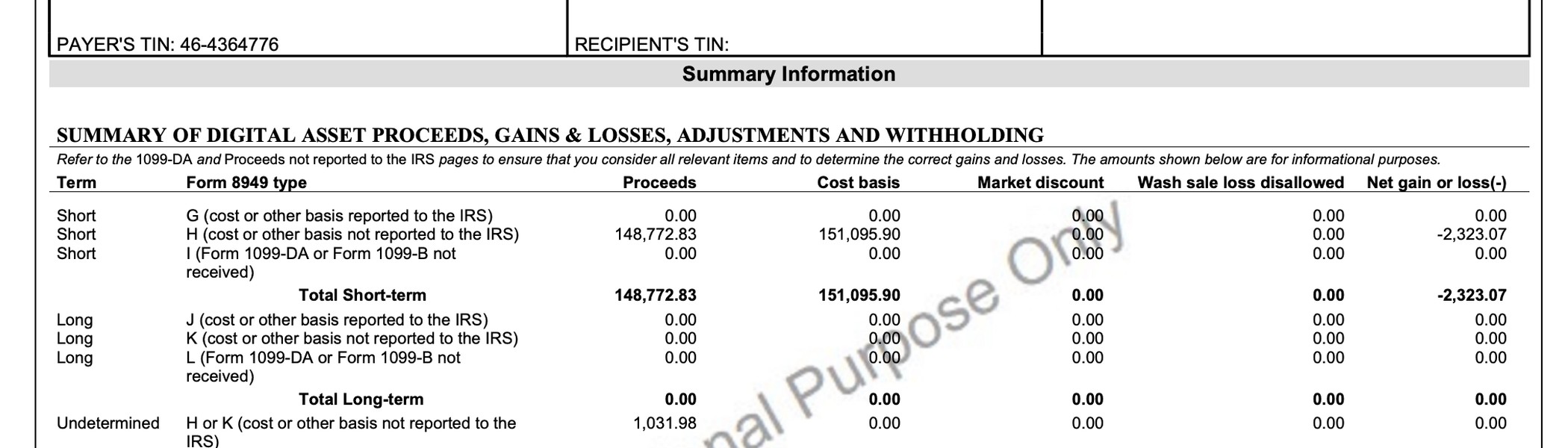
What is Form 1099-DA?
Every crypto exchange must now report your transaction data — proceeds, dates, asset types — directly to the IRS before you file your return. The IRS algorithm matches that data against your return automatically. Mismatches generate CP2000 notices with no human review.
The form is filed with the IRS and a copy is provided to the customer. Beginning with the 2025 tax year, brokers report gross proceeds. Cost basis reporting follows in subsequent years.
This page is educational only. Always consult your CPA, tax attorney, or enrolled agent for advice specific to your situation.
Form 1099-DA at a glance
- Filed by the broker, copy issued to the customer
- Reports gross proceeds from sales and dispositions
- Cost basis reporting phases in over multiple years
- IRS uses it for automated matching against your return
Form 1099-DA — effective for tax year 2025 and beyond.
Three patterns that produce IRS notices.
Ghost Basis
If your cost basis is missing, the IRS treats it as $0. Every dollar of proceeds becomes fully taxable. Ghost Basis arises when assets move between wallets and exchanges without documentation.
Automatic Matching
There is no longer a gap between what you report and what the IRS already knows. Their algorithm matches exchange data against your return automatically and flags discrepancies.
Burden of Proof
The IRS does not have to prove anything. You do. When a mismatch surfaces, the burden of documentation falls entirely on the taxpayer.

What Is a CP2000 Notice?
A CP2000 is an automated IRS notice generated when your filed return does not match third-party data the IRS received. For crypto investors, this means exchange-reported proceeds that do not match your Schedule D. The notice proposes additional tax, penalties, and interest.
- 01The reporting periodConfirm the tax year and your identity. Do not respond to a notice that does not match your records.
- 02Items reported by third partiesCompare line by line to the 1099-DA, 1099-B, and other returns issued to you.
- 03Items shown on your returnLocate every item on your filed Schedule D, Form 8949, and supporting workpapers.
- 04The proposed changeThe IRS computes the difference and proposes additional tax, interest, and penalties.
- 05Response options and deadlineAgree, disagree with explanation, or partially agree. The deadline is firm. Engage your CPA immediately.
A short checklist before the next filing season.
Reference materials and guides.
The Crypto Tax Threat Matrix
A strategic assessment of risk in the era of AI-driven enforcement. How to determine if your crypto reporting is at risk.
Download PDFCPA Professional Briefing
The Crypto Audit-Ready Client Kit. Cleaner records in, safer returns out. A professional briefing for CPAs.
Download PDFScore your 1099-DA exposure in five minutes.
The Crypto Tax Threat Matrix flags the categories that score your personal trading characteristics that make you more at risk. Free, no obligation.
The Crypto Tax Threat Matrix
A free self-assessment to determine your IRS scrutiny risk and tax return exposure. Identify the gaps before the IRS does.